Table Of Content

At the early stages of the design process, wireframes help you communicate incipient design ideas to stakeholders and collect feedback on the design before investing time in high-fidelity prototypes. Wireframing is one of the first steps in the UX design process and involves creating simplified representations of a page interface. The focus of wireframing is on defining the layout and basic elements of a design.
What Is a Content Strategist?
The launch is when your product, carefully designed and tested based on user needs and feedback, finally goes live. For embedded design teams, there are both design team cadences and cross-functional team cadences. But at a minimum, the design team will meet at least once weekly to align on roadblocks, responsibilities, deliverables, and deadlines. Paper prototyping is used to make sketches of the future system design with pencils, markers and sticker notes. Paper prototyping is a great UX design technique because it allows to quickly explore different design variants and experiment with design solutions individually or in teams. Persona is a collective image of users united by similar goals, priorities, skills, behavior patterns, characteristics, motivations and intents.
Phase 1: Kickoff & Workshop
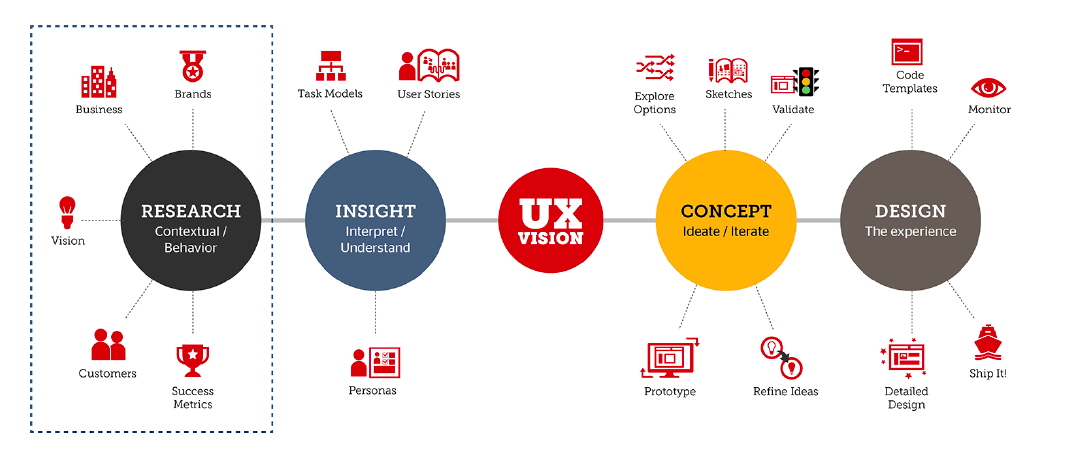
The mistake many beginners make is to focus too heavily on listening, whereas observing users can uncover a lot more in less time. For those working on a redesign of an already existing product, they have the benefit of directly seeing how users respond to an existing system. Put simply, our users don’t have the benefit of this experience and knowledge. For a beginner’s introduction to the broader stages, check out the video below by senior UX designer Dee Scarano, or read on for more detailed explanations. Wouldn’t it be easier to design effectively if you knew step by step what to do? However, a linear approach can be difficult to incorporate in real-world scenarios, especially when you're working with a live product and have a long backlog of features that need to be shipped.
What kind of Experience do you want to share?

Interviews with users from the target audience can help you to uncover user needs and issues. For more on this topic, see our articles on how to create a winning UX strategy that meets user and business needs and how to create an effective UX roadmap that aligns stakeholders. But the benefits go far beyond the users, as UX design is becoming increasingly instrumental in delivering value to the business as well. It makes moving from raw data to actionable insights fast and straightforward, allowing you to uncover themes and trends and take appropriate action quickly. Designing based on assumptions about your users' wants and needs is often problematic.
Step 4: Prototyping
Here, the collaborative efforts of designers and developers meld, translating design prototypes into functional, interactive interfaces. The UX design process is essential for creating compelling digital experiences that enhance user engagement and meet organizational goals. By following the proper steps and best practices, you can maximize your UX process to ensure you address all user needs while optimizing for success. As a best practice, one or two designers should stay on the project throughout the hand-off phase to ensure development has the support they need to implement the design.
User journey maps
By following the overarching UX process, your team will be more able to design and develop genuinely relevant and satisfying products for the end user—essential for the users and the business to thrive. Skipping UX design process steps can lead to subpar results, incomplete research, and insights that don’t solve the core problem. The principles of UX design help ensure that products and services will be a good market fit, that they’ll be easy to use, and that they will solve the intended problem. Once the wireframes are established, prototyping is usually the next phase. A prototype is a low-cost interactive version of the product created to allow users to view and try it before investing time and money in making it. Once you discover actionable insights, you can embed them into the design process to enhance the overall user experience.
Black People Have Always Been UX Designers: Space-Making Is An Iterative Design Process - People of Color in Tech
Black People Have Always Been UX Designers: Space-Making Is An Iterative Design Process.
Posted: Fri, 21 Jun 2019 07:00:00 GMT [source]
A prototype is a simulation that shows how users will interact with the finished product. Prototypes can be interactive and clickable, allowing stakeholders (and sample users) to interact with them as if they’re a live product. Some common UX research methods include user interviews, surveys, A/B tests, card sorting, first-click tests and eye-tracking. The research stage can also involve researching competitors to see what’s already on the market. CareerFoundry is an online school for people looking to switch to a rewarding career in tech.
Build a Design System
These are essential questions to ask so everyone feels supported and the right people can get involved early. Donald Norman, an Apple employee, coined the term "user experience" in 1993 to describe how users interacted with a product throughout development. It highlighted accessibility, discoverability, and efficiency as ways to meet customer needs. Often, wireframes can be organized into clickable prototypes using such tools as Marvel or InVision app.
You’ll Love Being a UX Researcher If You…
UX designers create mockups and prototypes too, but these tend to be less focused on the “look” of the product and more on the “feel” of it. This involves speaking to or observing real users (or people who represent your target users) to figure out what problems they have and what they desire and require from a solution. The purpose of in-person usability testing is to identify problems or issues the user has with the interface and why these issues arise. Now that your design has been thoroughly tested, refined, and validated through usability testing and iteration, it’s time to move forward with the development and implementation phase.
It begins with the identification of a problem; this is often found through user research, and if it’s not, it will then be confirmed through user research. There is no point in solving problems that users don’t care about; they won’t pay to solve those problems, and that means your company won’t make money. Graphic designers are hence very often emotional designers who elicit specific reactions in a user.
Embrace a culture of continuous improvement and use feedback to refine your designs, so the final product meets the needs and expectations of both the users and the business. The design thinking process should not be seen as a concrete and inflexible approach to design; the component stages identified should serve as a guide to the activities you carry out. The stages might be switched, conducted concurrently or repeated several times to gain the most informative insights about your users, expand the solution space and hone in on innovative solutions.
They empower designers to visualize, test, and refine their creations, ensuring users enjoy seamless, intuitive experiences. Let’s dive into some of the most renowned UX design tools in the industry. Not only does this stage help in visualizing the result, but it also identifies potential usability issues early on.
Within a start-up, a UX designer can be responsible for every part of every process, due to small budgets, small teams, and limited resources. Remember the earlier you test, the easier it is to make changes and thus the greater impact the testing has on the eventual quality of the product. User testing can be as simple as making paper prototypes or drawing whiteboard sketches to demonstrate your product to your potential users. You can repeatedly test using these simple methods until an acceptable solution to an obstacle has been found. You can also use your prototypes to test out more interactive elements on users. A user who is overwhelmed by too much information or gets ‘lost’ navigating through a site is going to have a bad experience of that product, brand, or service.
It encompasses a variety of feelings including emotion, senses, and physical interaction. It's easy to get caught up in the latest trends and fads the pop in and out of web design. But rather than try and have the hippest and coolest of web designs, it's better to create something that never falls out of touch with what end users want.


No comments:
Post a Comment